
Crate assembly robot – Production process automation
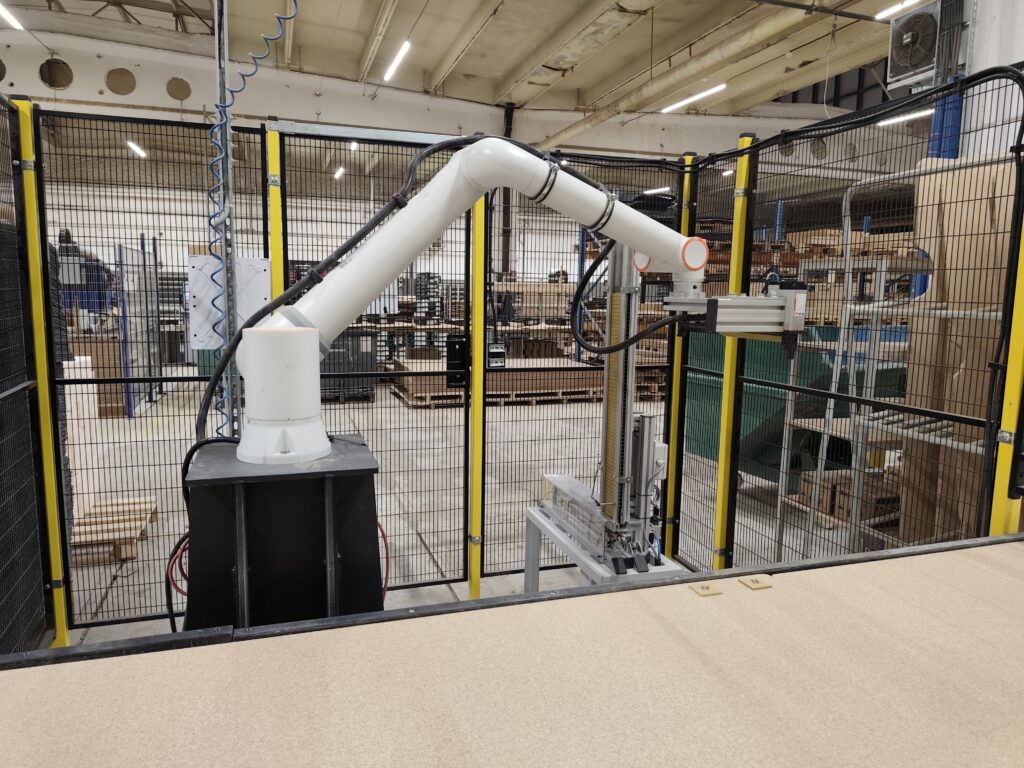
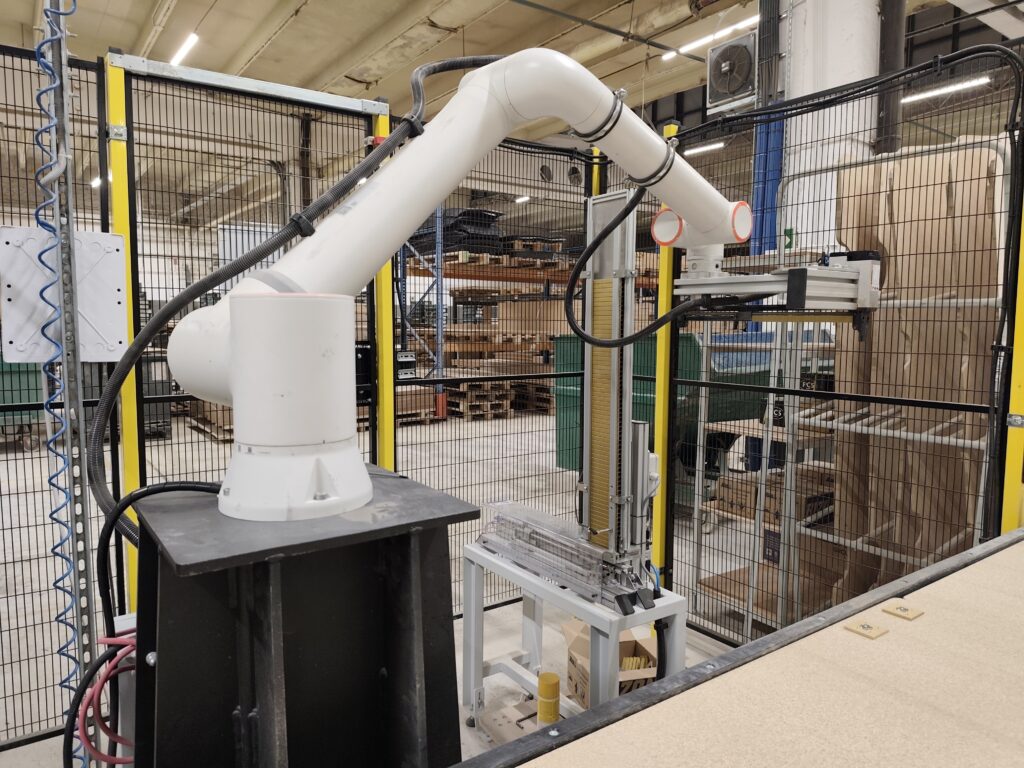
Crate assembly robot designed and implemented by Automation Dariusz Kulik is an advanced robotic workstation that automates the crate assembly process. The crate assembly robot replaced manual assembly operations, significantly increasing production efficiency and repeatability across the entire production line.
Crate Assembly Robot – Project Description
The robotic crate assembly project was implemented for a furniture manufacturer (bed boxes). The crate assembly robot operates continuously, executing assembly tasks with high precision and repeatability that cannot be achieved through manual labour. The implemented solution includes a robotic arm with a gripping end-effector, integrated with a part feeding system and PLC control unit.
Project Objectives and Automation Goals
The main goal of deploying the crate assembly robot was to increase production efficiency while reducing repetitive manual operations. Key issues identified before implementation: inconsistent manual assembly output, risk of workplace injuries, high defect and scrap rates, and downtime caused by workforce absence. The crate assembly automation project addressed all these challenges with a comprehensive robotic solution.
Technical Solutions Applied
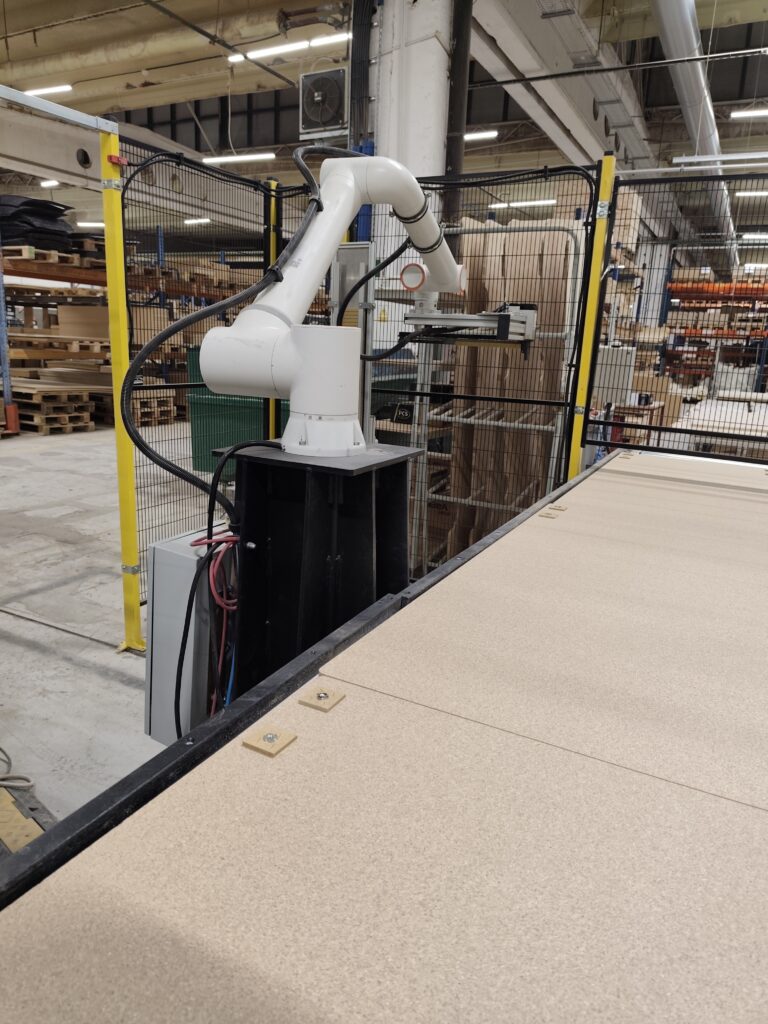
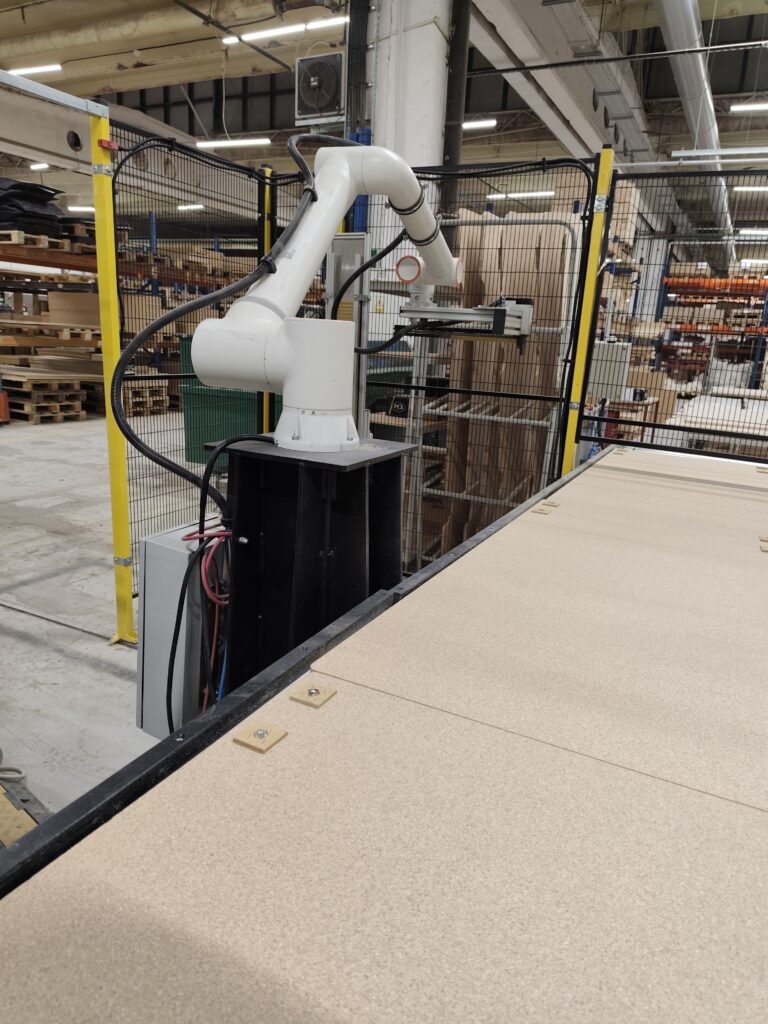
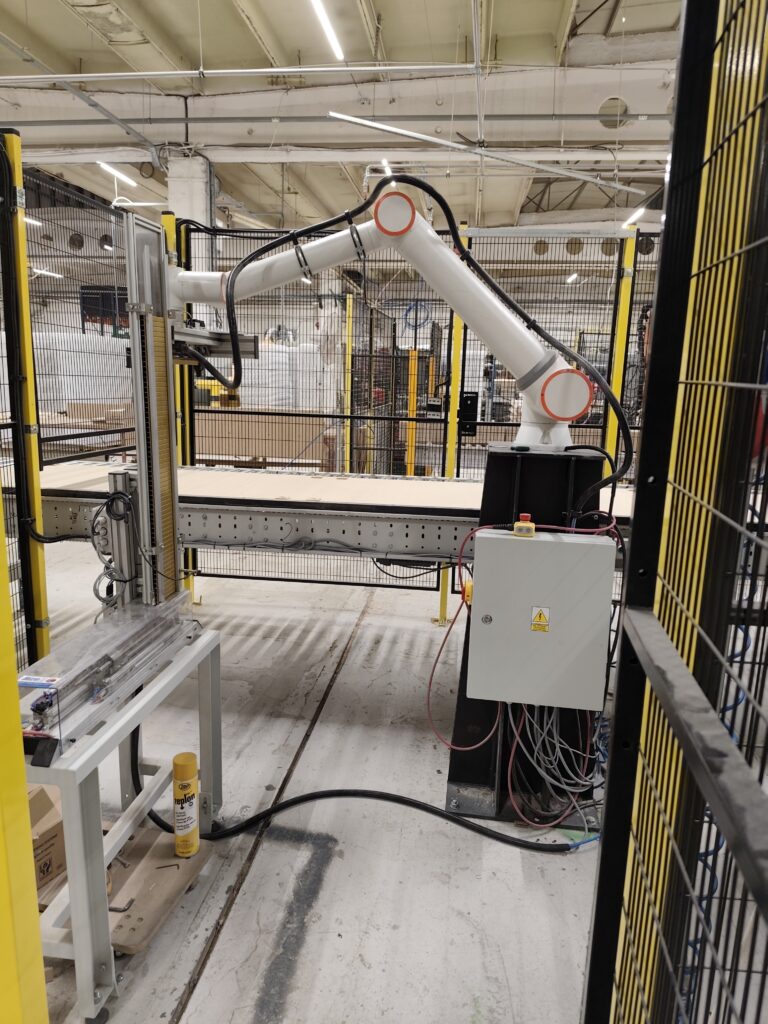
The crate assembly robot project incorporated: a 6-axis robotic arm with a dedicated gripper for wooden components, a vision system for part position detection, a PLC controller managing the station’s work sequence, pneumatic feeding and safety systems, and safety guards selected on the basis of the risk assessment, with the cell covered by a declaration of conformity and CE marking. The station was fully integrated into the existing production line without interrupting production continuity.
How such a project looks from the decision-making side – selecting a gripper for deflection-prone components, changing over to another size without the integrator, and the conditions under which robotic assembly makes sense – is covered in our article on furniture production automation.
Results – Impact of the Automation
Implementing the crate assembly robot delivered measurable results: production output increased by over 40%, human error in the assembly process was eliminated, the station operates in 3-shift mode without additional staffing, and working conditions at adjacent stations improved by removing noisy manual operations. The robotic crate assembly station delivers return on investment within a few months of operation.
Project Video
We present the implementation of a robot for assembling crates, implemented as part of the production process.
The aim of the project was to increase efficiency, improve repeatability, and reduce manual operations. The robotic station allows for stable and precise work, minimizing the risk of errors and downtime.
The solution was tailored to the specifics of production and integrated with the existing line, ensuring a smooth process.
Why Automate Your Production Processes?
Industrial process automation is an investment that delivers measurable returns in a short timeframe. Companies that have implemented robotics and automated systems report: productivity increases of 30–300% depending on the process, reduced labour costs while maintaining product quality, process repeatability independent of human factors, the ability to run 24/7 production without breaks, better quality control through real-time parameter monitoring, and improved worker safety by eliminating hazardous manual operations.
Automation Dariusz Kulik – Our Approach to Projects
Automation Dariusz Kulik delivers industrial automation projects end-to-end – from client needs analysis, through technical design and component selection, to manufacturing, commissioning and ongoing service. We approach every project individually, selecting the most technically and economically optimal solutions. We specialise in Xinje PLC controllers, HMI panels, servo motors and inverters, as well as robotic systems, CNC machines and assembly lines. Our completed projects span the food, metalworking, timber, packaging and chemical industries. Contact us to discuss your automation project.
Crate Assembly Robot – Workstation Specification
The robotic crate assembly station features a robotic arm adapted for handling heavy wooden components. The station’s safety system includes light barriers, laser scanners and emergency stop buttons positioned at access zones. The crate assembly robot’s control software allows easy programme switching for different crate types without involving an integrator. The HMI panel enables the operator to monitor station performance and run diagnostics in real time. The crate assembly robot operates at over a cycle of around 40–45 seconds per crate while maintaining full product quality.
Robot Integration with the Production Line
The crate assembly robot was integrated with the existing production line using conveyors and inter-operation buffers to ensure continuous material flow. Communication with the supervisory MES/SCADA system uses Modbus TCP protocol. The crate assembly robot automatically adjusts its work pace to match adjacent station throughput, preventing downtime and bottlenecks on the line. Integrating robotic systems into existing production environments is one of the key strengths of Automation Dariusz Kulik’s offering.
Like this realization?
Contact us and let's discuss your project