Machine Retrofit or a New Machine?
Machine retrofit or a new machine? Five signs your controls are at end of life, costs from €7,000, 1–3 month lead times, and when to buy new.
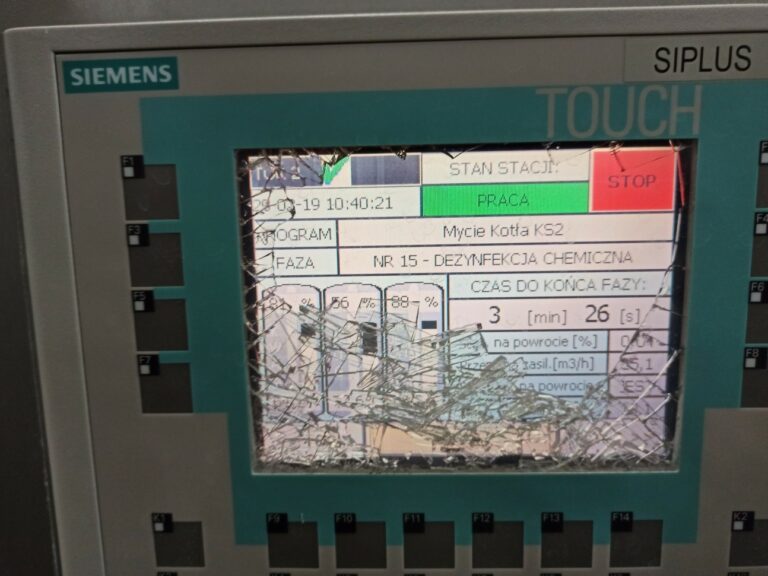
A machine has been down for two days because the operator panel failed. The service engineer says the part is no longer available and the manufacturer ended support eight years ago. The question that follows is invariably the same: continued repair, retrofit, or purchase of a new machine? In 15 years of working with manufacturing plants in north-eastern Poland all three outcomes have been observed – repairs that merely postponed the inevitable, retrofits that preserved a budget, and retrofits that amounted to expenditure without return. The specifics follow: the indications that controls are reaching the end of their life, the actual cost of a retrofit, and the circumstances in which the honest answer is „buy a new machine”.
Table of contents
Five signs that machine controls are nearing the end of their life
The mechanical side of a machine can run for twenty years or more. Electronics and controls age considerably faster, and are consequently the usual reason for withdrawing an otherwise sound machine from service. These symptoms repeat in almost every plant:
- Spare parts have dried up – the manufacturer has ended support for the series, and the PLC or panel is obtainable only on the secondary market, without warranty and without assurance of correct operation.
- Breakdowns are becoming more frequent and lasting longer – the maintenance team is fault-finding by trial and error, since diagnostic tools for a platform of that age are no longer available.
- There is no documentation and no source code – the program in the PLC works, but its precise function is no longer known. Every change to production consequently becomes a risk.
- Nobody programs it any more – the programming software requires a PC running an operating system from two decades ago, and the specialists familiar with it are very few in number.
- Operators run the machine from memory – because half the buttons on the panel no longer function and the display is illegible. This constitutes a safety issue, not merely an inconvenience.
Where at least three of the five are present, the question is not whether the machine will stop but when. Such a failure typically occurs at the least favourable point in the season.
What a machine retrofit covers, and what stays in place
A retrofit – modernising the control system – means replacing what has aged technologically while keeping what is still mechanically sound.
Usually replaced: PLC, HMI panel, variable-speed and servo drives, sensors, safety circuits and components, wiring and the control cabinet.
Usually kept: the supporting structure, guides and slideways, gearboxes, pneumatic cylinders and actuators – the whole mechanical side, provided it is in good condition.
That distinction is the heart of the decision. A retrofit makes sense when the machine is mechanically sound and only the controls are obsolete. A new PLC will not remedy play in worn guides or a cracked frame. This is addressed below, in the list of cases in which a retrofit is not advised.
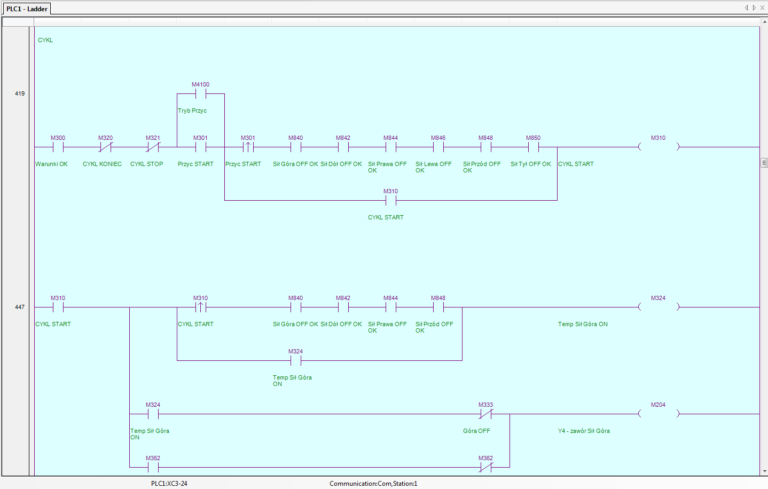
There is one more stage that is easy to overlook when planning. Before we dismantle anything, we read out and archive the existing PLC program and HMI project, and carry out a full I/O survey. If the PLC is password-protected or know-how protected and cannot be read, this is stated at the survey stage; the logic must then be reconstructed by observation of the process, which affects both the cost and the timescale.
The cost of a machine retrofit compared with the purchase of a new machine
All figures below exclude VAT. These are indicative ranges – we prepare a specific quotation after inspecting the machine.
- Replacing the controls of a single machine: PLN 30,000–50,000 (approx. €7,000–12,000). A new PLC, HMI panel and variable-speed drives. This represents the lowest entry cost; a full scope with a new cabinet and field wiring is higher.
- Modernising a complete line: PLN 80,000–400,000 (approx. €19,000–93,000). The spread is wide, and costing is accordingly carried out on the specific machine; on the projects completed to date, however, a retrofit amounted to a fraction of the price of a new line with comparable capability.
- A new machine: the full market price plus what is easy to forget when comparing offers: lead times measured in months, site preparation, new training, and sometimes a change to the shop-floor layout.
Time matters just as much. A control system modernisation usually takes 1–3 months from contract signature to acceptance on the shop floor. For a new machine it is usually six months or more, counting from order to full output. Replacement of the panel alone can be considerably quicker – the case described below was completed in a week – however, a full control retrofit remains a matter of months rather than days.
Machine downtime is counted separately, and it is the primary concern of a production manager. The preparatory work – the I/O survey, design, cabinet build and testing at our workshop – happens while production continues. On site, the machine typically stands from a weekend for a panel and PLC swap, up to a few days when the cabinet and field wiring are replaced. The slot is agreed in advance and the old cabinet is left serviceable until handover, so that reversion remains possible should difficulties arise. Following start-up, a further few days are allowed for fine-tuning and shift-side support.
A new machine does bring advantages a retrofit cannot: a manufacturer’s warranty, years of service support, higher throughput, and a complete documentation package with CE marking. Where those considerations prevail, the return should be calculated in the same manner as for any other investment – we covered that in our guide to automation costs and ROI.
Case study: the HMI panel on a CIP station
At a dairy plant, the Siemens operator panel controlling the CIP station – which cleans the process pipework in place, without dismantling it – stopped working. The cleaning cycle halted, and in a food plant that means not only downtime but a risk of microbiological contamination in the pipework. A like-for-like replacement from the manufacturer meant a high cost and a long lead time.
We proposed modernisation instead: a Xinje TG series panel with the process screens rebuilt on it. We recreated every wash screen – temperature, flow and CIP phases. We kept the alarms and the data history, and reconfigured the communications link to the existing Siemens S7 PLC. The PLC and the plant infrastructure were left untouched.
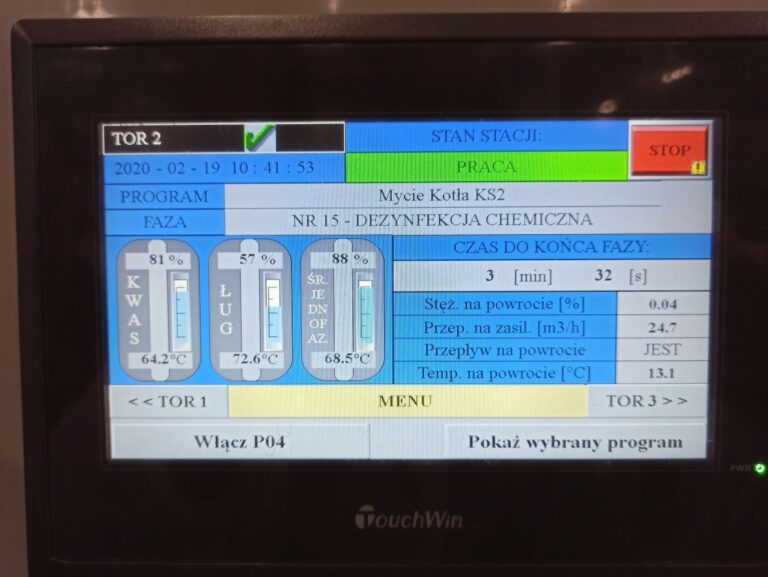
The results: roughly 70% saving against the price of the original panel, the job completed in under a week from order, and screens that looked identical to the originals, so operators needed no retraining. The details are in our project write-up: CIP station modernisation in a dairy plant. Hygiene requirements and control of the whole CIP station are covered in our article ‘Automation in the Food Industry’.
In the dairy described above, replacing the panel alone took under a week from order; a retrofit of a machine’s entire control system usually takes 1–3 months from contract signature to acceptance. It should also be noted that swapping the panel without touching the PLC is not always that simple – prior to quotation, five matters are verified:
- whether the new panel has a communications driver for that specific interface – with Siemens, MPI/PPI, PROFIBUS and Ethernet are three different propositions;
- whether an address map and tag list for the PLC are available, because reconstructing them can cost more than the panel itself;
- whether the original HMI project can be recovered in order to rebuild the screens – this often needs an archived software version and a licence;
- whether recipes and process settings were held in the panel or in the PLC – if they were in the panel and the panel has failed, they may be unrecoverable;
- whether the panel cut-out and IP rating suit the existing cabinet – in a dairy, with washdown, the IP rating matters.
When a machine retrofit is worth it
A retrofit is worth it when three conditions hold at once: the machine is mechanically sound, only the controls are obsolete, and the cost of modernisation stays below roughly half the price of a new machine with comparable capability. If any one of those conditions is not met, the funds are usually better allocated towards a new machine.
When a machine retrofit is not worth it
The following are the cases in which a retrofit is not advised:
- The mechanical side is worn out – play in the guides, worn bearings, cracks in the frame. New electronics will not restore the geometry; repeatability will remain unchanged, however new the PLC.
- The machine cannot keep up with your requirements – where twice the output is required and the machine cannot run any faster, modernisation of the controls changes nothing.
- The product has changed – the machine performs well on a product that is no longer sold, and its conversion would require a mechanical rebuild.
- The retrofit cost approaches the price of a new machine – once it passes roughly half that figure, the manufacturer’s warranty, support and complete CE documentation usually win.
- Safety requirements force a rebuild – guarding and fencing sometimes call for structural changes whose cost changes the whole calculation.
Retrofits and compliance: safety, CE and substantial modification
Clients rarely raise this question, although it can prove decisive for a budget. The starting point is the aspect that applies to almost every retrofit.
Safety functions are a separate matter. If the work covers safety circuits and components – emergency stops, light curtains, safety relays or a safety controller – then regardless of how the project as a whole is classified, the risk assessment has to be updated, the required Performance Level determined and verified to EN ISO 13849-1, validation carried out to Part 2, and the documentation completed. This is included in the scope from the outset rather than added after handover.
Replacement of a PLC or panel with a functionally equivalent unit is usually not a substantial modification. The test, however, is not output but risk: a substantial modification is one that creates a new hazard or increases an existing risk to the point where the current safeguards are no longer adequate. Raising speed or changing the machine’s function matter precisely because they usually do that. The CIP panel replacement described above – the same screens rebuilt, with no change to the PLC or the process – did not fall into that category.
The consequence is significant: the party making a substantial modification takes on the obligations of the manufacturer of the modified machine – a new risk assessment, technical file, declaration of conformity and CE marking. Who takes on that role is agreed in the contract before work starts, not after handover.
There is a further reason to settle it now. From 20 January 2027 the EU Machinery Regulation (EU) 2023/1230 applies, replacing the existing Machinery Directive and defining substantial modification directly in law for the first time – as a change not foreseen by the manufacturer that creates a new hazard or increases an existing risk. Projects signed now but handed over in 2027 are worth planning against those requirements from the start. (Where machinery is placed on the GB market, the equivalent rules are the Supply of Machinery (Safety) Regulations 2008 rather than CE marking.)
It is worth settling this at the concept stage rather than after commissioning. In borderline cases, a written opinion from an independent machinery-safety specialist is good practice – that consultation costs a fraction of what it costs to rework the machine after handover. It should be noted that most production machinery is self-certified by the manufacturer; a notified body is involved only in the high-risk categories listed in the legislation.
What is provided at handover
A modernisation that resolves the present problem but leaves the plant in exactly the same position in ten years is not a good modernisation. Accordingly, the full set is provided at handover: as-built drawings, the signal list, copies of the PLC and HMI projects, passwords, licences and a recommended spare parts list. We do not leave behind a machine that only we are able to service five years from now.
The practical side of these topics — scope of work, budget bands and lead times — is described on the machine retrofit and modernisation service page.
Frequently asked questions
How much does a machine retrofit cost?
Replacing the controls of a single machine is typically PLN 30,000–50,000 (approx. €7,000–12,000) excluding VAT, and modernising a complete line PLN 80,000–400,000 (approx. €19,000–93,000). The final figure depends on the number of drives and sensors, and on whether the control cabinet and field wiring are replaced as well.
How long does a machine retrofit take?
Counting from contract signature to acceptance on the shop floor, usually 1–3 months. Actual machine downtime is far shorter – from a weekend for a panel and PLC swap to a few days when the cabinet and wiring are replaced – because the preparatory work is done while production continues.
Can the HMI panel be replaced without replacing the PLC?
Yes, provided the new panel supports the PLC’s communications interface and we have access to the address map and tag list. That is how we handled the CIP station at a dairy plant – the Siemens S7 PLC was left untouched and only the operator panel was replaced.
Does a modernised machine need new CE marking?
It depends on the scope. Replacing a component with a functionally equivalent one usually does not require a new conformity assessment. If the work creates a new hazard or increases an existing risk, however, it is a substantial modification – and the party that carried it out takes on the manufacturer’s obligations. We establish the scope at the concept stage.
Is funding available for machine modernisation?
The Polish robotisation tax relief generally does not cover it – the relief applies to the purchase of new industrial robots and related equipment, and replacing the controls of an existing machine does not fall within that. Regional programmes may have a broader scope. The relief itself is available to Polish CIT and PIT payers and, in its current form, covers costs incurred up to the end of 2026. It is worth confirming eligibility with your accountant before applying.
Book a free visit – we will tell you if a retrofit is worth it
This cannot be assessed from a catalogue – we need to see the machine and check the condition of the mechanical side. We will visit your site, look at the equipment and tell you plainly whether a retrofit makes sense or whether the money is better saved towards a new machine. The visit is free and without obligation, and you receive a budget quotation within 48 hours of the visit. We work across the Podlaskie region of north-eastern Poland and deliver larger projects elsewhere in Poland. Examples of our work are in completed projects.
📞 Call: +48 796 019 414
✉️ biuro@automation.net.pl
📍 Automation Dariusz Kulik, Ciesielska 2/20, 15-542 Białystok, Poland – contact details