Machine Retrofit CE Marking – When Does a Retrofit Require a New Conformity Assessment?
When a machine retrofit requires a new conformity assessment and CE marking: four qualifying questions, manufacturer obligations, risk assessment.
Machine retrofit CE marking is often treated as paperwork to be settled after handover. In practice the question is decided far earlier – when the scope of work is agreed. The scope of the change determines whether the manufacturer’s original declaration of conformity still holds. If it does not, either the end user or the integrator carries out a new conformity assessment and takes on the obligations of a manufacturer.
Table of contents
Machinery Directive and the legal status of a retrofitted machine
A machine placed on the market with CE marking has undergone a conformity assessment carried out by its manufacturer. The declaration covers a defined configuration and a defined intended use, and nothing beyond it. Replacing a controller, adding a feeder or integrating the machine into a line may leave the machine in a condition the manufacturer’s document no longer covers, if those changes go beyond what the manufacturer foresaw.
The decisive concept is substantial modification. Machinery Directive 2006/42/EC applies up to and including 19 January 2027; it does not define the term explicitly, and practice relies on European Commission guidance and national interpretative documents. From 20 January 2027, Regulation (EU) 2023/1230 applies in its main body, and the definition appears in the text of the Regulation itself. Which instrument governs a given project is determined by when the retrofitted machine is placed on the market or put into service – in practice at handover and commissioning – not by the date the contract is signed or work begins.
The Regulation does not apply retroactively: machines placed on the market before 20 January 2027 in accordance with Directive 2006/42/EC keep their status.
Substantial modification – risk, not throughput
The most common misconception equates substantial modification with an increase in output. A retrofit that raises line throughput by half need not be a substantial modification, provided it creates no new hazard and does not increase an already identified risk. Conversely, a change that is neutral in throughput terms but gives the operator access to a danger zone will be a substantial modification if the existing safeguards are no longer sufficient.
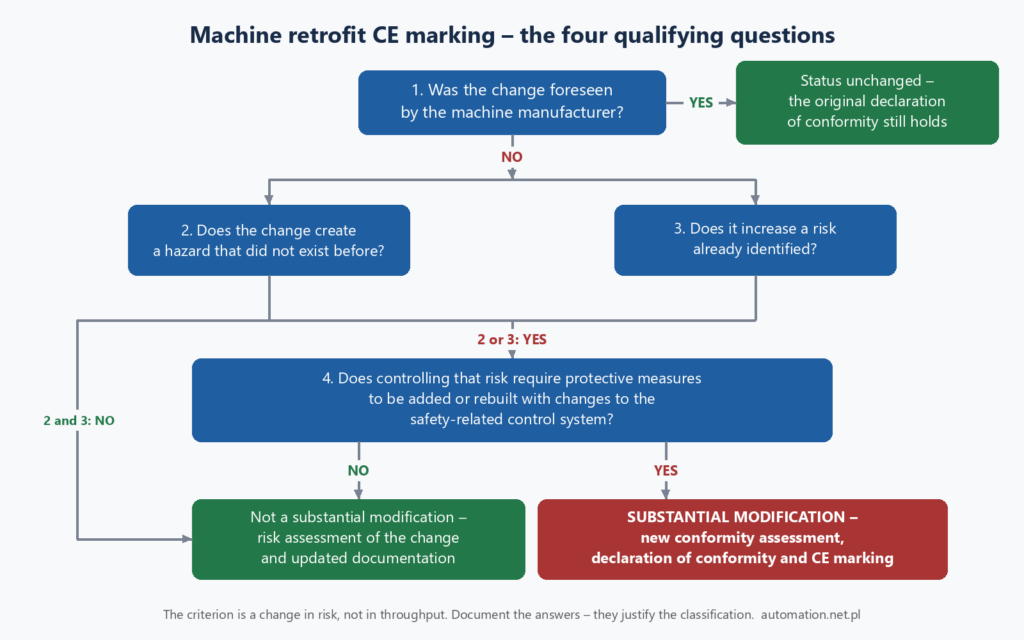
Four questions, asked before the scope of work is fixed, structure the classification:
- Did the manufacturer foresee the change? An extension carried out as documented, using the interfaces and options provided, does not alter the machine’s status – and the analysis ends there.
- Does a hazard appear that was not there before? What matters is the type of hazard, not the mere fact that something has changed. Adding a rotary axis introduces a crushing hazard the machine did not previously present.
- Does an already identified risk increase? The hazard stays the same, but a change in force, kinetic energy or how often the operator reaches into the danger zone raises the risk level. Fitting a drive with different braking characteristics can lengthen the stopping distance and thereby invalidate previously calculated safety distances.
- Does controlling that risk require protective measures to be added or rebuilt, with changes to the safety-related parts of the control system? This is the qualifying condition. If the hazard is controlled by protective measures already present, or if adding a simple measure suffices – for example a fixed guard – without altering the safety-related parts of the control system, there is no substantial modification. An interlocking guard wired into the safety circuit usually does alter them.
A yes to the first question closes the matter. Otherwise, a substantial modification is established by a yes to the second or third question combined with a yes to the fourth. The answers should be documented – they justify the classification and are subject to scrutiny on a par with the risk assessment itself.
The definition in Article 3(16) of the Regulation covers physical and digital changes alike – a change to the controller program that affects safety functions can also be a substantial modification. Besides adding guards or protective devices that require changes to the existing safety control system, the test is also met by additional measures needed for the machine’s stability or mechanical strength. Under recital 26 of the Regulation, repair and maintenance that do not affect the machine’s compliance are not substantial modifications.
Machine retrofit CE marking and manufacturer obligations
The consequence of a substantial modification goes further than most end users assume: whoever makes such a change assumes a manufacturer’s obligations so far as the modification extends. Machine retrofit CE marking is therefore not a separate administrative step but the last one on a full conformity route, which comprises:
- a risk assessment of the machine in its modified state,
- selection of the applicable conformity assessment procedure – internal checks (internal production control under the Regulation) suffice for most machines, whereas machines listed in Annex IV to Directive 2006/42/EC (from 20 January 2027, categories in Annex I to the Regulation: mostly Part B; the narrow Part A always requires a notified body) require either full application of harmonised standards or common specifications, or the involvement of a notified body. The list covers, among others, certain cold metal-working presses and woodworking saws; a typical packaging machine or conveyor is not on it. As of early November 2026 the list of harmonised standards for the Regulation had not been published (the Commission expects a first list before the end of 2026), so the conformity assessment route for such machines should be settled at the quotation stage,
- updated technical documentation, including unmodified components affected by the change,
- a revised operating and maintenance manual,
- an EC declaration of conformity – from 20 January 2027, an EU declaration of conformity,
- CE marking together with a nameplate identifying the party that took on the manufacturer’s obligations and the year of the retrofit.
Linking several machines into a line controlled as a whole is a separate case: an assembly of machinery is created, requiring its own conformity assessment and its own declaration – even though each constituent machine carries CE marking of its own.
Where the end user orders the retrofit and an integrator performs it, the manufacturer’s obligations fall by law on the party that makes the substantial modification. The contract should state who carries out the modification and who prepares the documentation; if that is left unsettled, neither party holds a complete set of documents at handover. After an accident, the first question asked is who issued the declaration of conformity for the machine in the state in which it was operating.
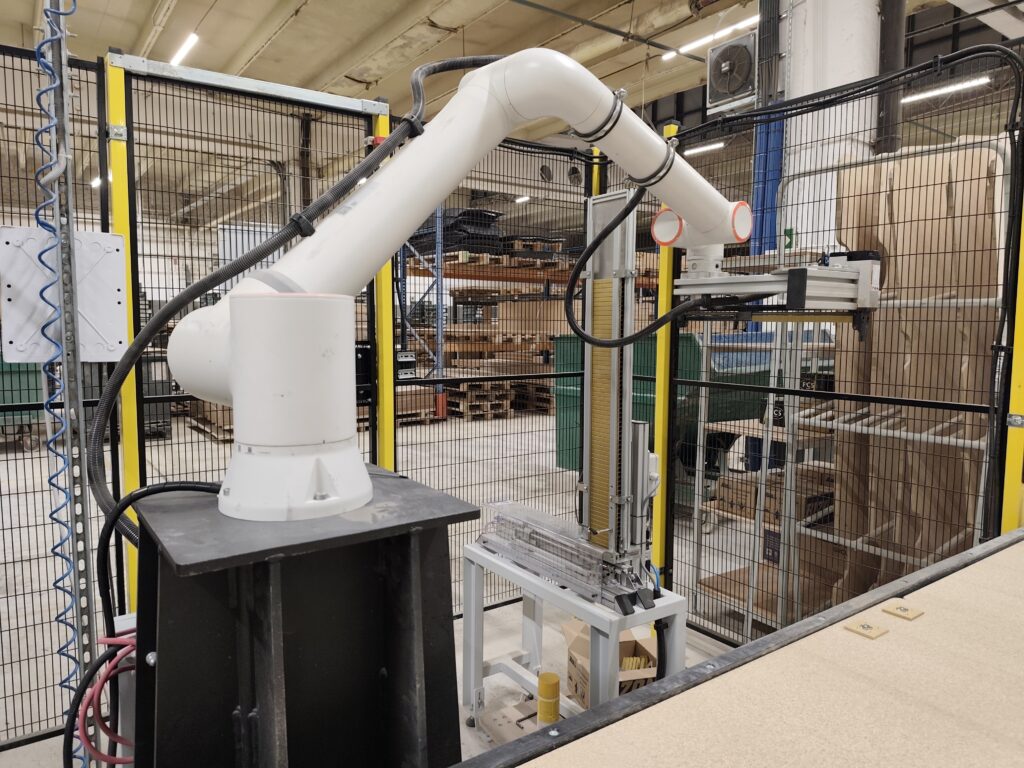
Machine risk assessment – the sequence
A machine risk assessment carried out before the retrofit usually changes its scope: it identifies what needs adding and where intervention is not justified. Carried out after the work, it is equally binding but forces rework on a machine that is already built. The sequence follows EN ISO 12100.
- Determining the limits of the machine – spatial, temporal and use limits, together with reasonably foreseeable misuse.
- Hazard identification across every phase of the machine life cycle: start-up, automatic operation, changeover, fault clearing, cleaning and maintenance.
- Risk estimation for each hazard – by severity of harm, frequency and duration of exposure, and the possibility of avoiding it.
- Risk evaluation – deciding whether the risk is acceptable or further reduction is needed.
- Risk reduction in order: inherently safe design, then safeguarding and complementary protective measures, and information for use last. The order is not a recommendation – a manual does not replace a guard.
The process is iterative: any protective measure introduced is itself reassessed, because it may bring new hazards.
Machinery safety standards and the required performance level
In a typical automated work cell a single switch is usually not enough: the performance level (PL) required here is most often PL d, usually achieved with a category 3 architecture – a redundant, self-monitoring circuit, so that a single fault does not lead to the loss of the safety function. The category alone does not decide the level: it also depends on component reliability (MTTFd), diagnostic coverage (DC) and common-cause failure measures. The required level (PLr) is determined separately for each safety function in accordance with EN ISO 13849-1, using the same parameters as risk estimation; the achieved level is calculated to the same part and validated to EN ISO 13849-2.
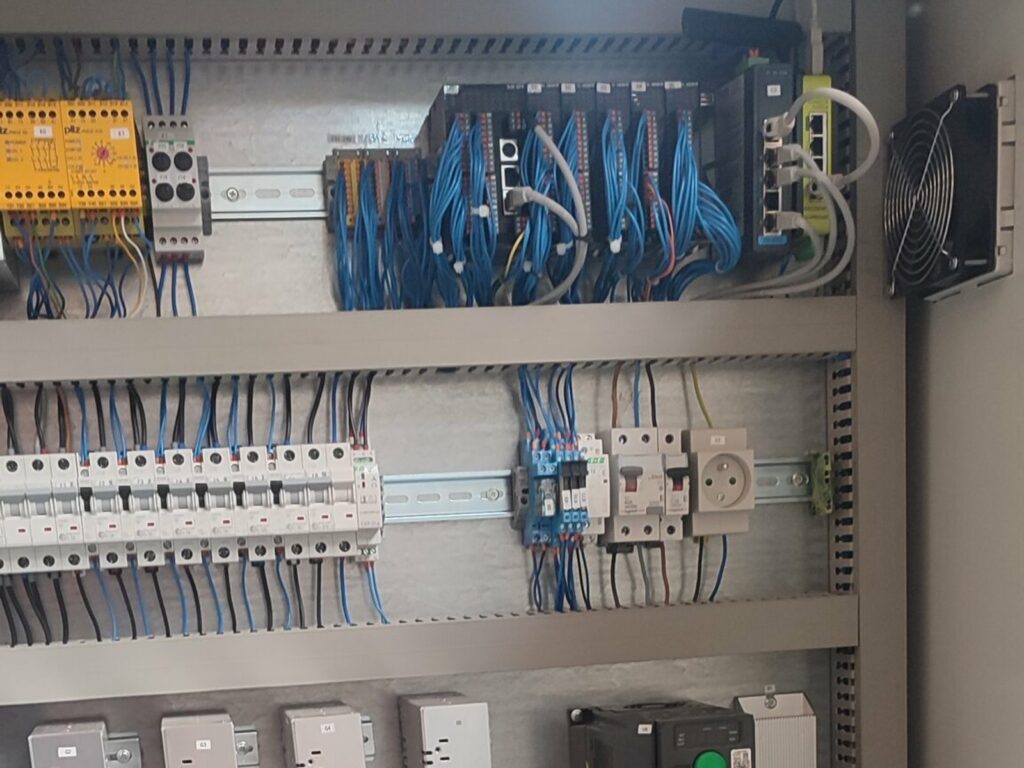
Safety functions are implemented by a safety relay or a safety controller, including over a network – PROFIsafe, CIP Safety, FSoE. A hardwired circuit is not the only permissible architecture: a networked solution simplifies wiring and diagnostics but lengthens response time, which feeds into the calculation of safety distances. On extensive lines this is a real trade-off, not a matter of preference.
Emergency stop deserves separate treatment. EN ISO 13850 requires a manually actuated latching device – typically a mushroom-head button, with rope-pull switches also permissible. A touchscreen does not replace it in any configuration, whatever the enclosure rating; the remaining selection criteria are covered in a separate article on choosing an operator panel. Emergency stop is a complementary protective measure, not a safeguard: it cannot take the place of a guard or other safeguarding, and it is not relied on as the means of achieving the required risk reduction.
Where a retrofit introduces a robot, the 2025 editions of EN ISO 10218-1 and EN ISO 10218-2 are applied in practice as well – both to new installations and to substantial modification of an existing cell. These editions also cover collaborative operation, previously described in technical specification ISO/TS 15066.
Machines without CE marking and retrofits without documentation
Machines placed on the market in Poland before 1 May 2004 – the date of EU accession, from which CE marking of machinery applies in Poland – generally carry no CE marking. A machine brought in from another EU country may have carried it earlier. Marking is not applied retrospectively merely to complete the paperwork on an old machine. If such a machine undergoes a substantial modification, however, it becomes subject to conformity assessment under the normal rules – and then it does receive CE marking.
Separately from CE status, machines in service are subject to the minimum requirements for the use of work equipment under Directive 2009/104/EC as transposed into national law, and the employer is responsible for meeting them. In Poland, machines acquired before 1 January 2003 had to be brought into line with those requirements by 1 January 2006, and the employer is in addition responsible for assessing and documenting occupational risk. Where the retrofit is not a substantial modification, it is therefore simpler in formal terms but does not remove the need for a risk assessment.
A frequent situation: the machine has a nameplate but no documentation – the manufacturer no longer exists, or the equipment was bought second-hand. The first qualifying question then cannot be answered, because there is no way to establish what the manufacturer foresaw. The response is to reconstruct the baseline: a survey of the control system, archiving of the PLC program, a description of the safety functions as found, and a risk assessment of the machine in its actual condition. Missing documentation does not block a retrofit; it changes the starting point and belongs in the quotation.
Documentation handed over at acceptance
What is handed over after a retrofit can be specified precisely, and is worth agreeing in the contract. A package covers at least:
- the risk assessment, with the justification for how the change was classified,
- a list of safety functions with required and achieved levels, and the calculations behind them,
- a record of measured stopping times and the safety distances derived from them,
- a functional test record for every safety function,
- updated electrical documentation and operating manual,
- a backup of the controller and panel programs, the safety controller configuration and the drive parameters, in editable form,
- a declaration of conformity together with the technical documentation, where the change was classified as a substantial modification.
Common mistakes on the shop floor
Defeating door interlocks. A switch bypassed with a piece of cardboard or a screw is the condition in which movable guards are most often found during inspections before a retrofit – an observation from our own projects. Interlocking devices are selected to minimise the possibility of defeat in a reasonably foreseeable manner – during a retrofit this has to be checked physically, not just on the drawings.
A light curtain mounted closer than the calculation allows. The distance follows from the actual stopping time, and after a drive retrofit that time is often different. A catalogue figure used instead of a measured one is a defect found at acceptance.
Treating component conformity as machine conformity. CE marking on a drive, a controller or a light curtain does not transfer to the machine as a whole. Safety is established at system level, and that is where it is assessed.
Not archiving the baseline. Before work starts, the existing controller program, documentation and declarations should be archived. Without them it becomes impossible to show what actually changed – and it is the extent of the change that decides the classification. This is the first task to carry out, before any conversation with an integrator.
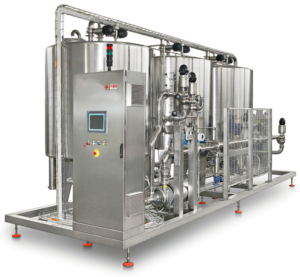
One example of a scope that generally does not amount to a substantial modification is the CIP station retrofit at a dairy: in the first stage only the operator panel was replaced, with the existing visualisation transferred to it, and the S7 controller was left unchanged. Any later change of function, for example an additional wash programme, needs a separate classification. The choice between retrofitting and buying new is covered separately in Machine retrofit or a new machine?; the scope of work is described on the Machine retrofit page.
The above describes the general approach; classifying a specific change requires an assessment made for that machine.
Frequently asked questions
Does a machine retrofit require CE marking?
CE marking after a retrofit is required where the change amounts to a substantial modification – that is, it creates a new hazard or increases an already identified risk, and containing that risk calls for guards or protective devices whose addition requires changes to the safety-related parts of the existing control system, or for additional measures to ensure the machine’s stability or mechanical strength. A retrofit foreseen by the manufacturer that leaves the risk unchanged does not invalidate the existing declaration of conformity.
Does replacing a PLC require new CE marking?
Replacing a controller with a newer one, while keeping the machine’s functions and the existing performance level of its safety functions, is usually not a substantial modification and therefore does not call for new CE marking. Moving the program to a new controller may, however, change scan time and response times; where the controller is part of the stopping chain, stopping times are measured again after the replacement and every safety function is retested. In older machines, safety functions are often implemented in standard controller logic, so moving them to a safety-rated controller or circuit entails rebuilding the safety-related circuits as well – and then reassessment is necessary, since a change to the program that affects safety functions can itself be a substantial modification.
Is increasing line throughput a substantial modification?
Increasing line throughput is not in itself a substantial modification – the criterion is a change in risk, not in production parameters. Higher output is often accompanied by higher speeds of moving parts, which can change stopping times and invalidate previously calculated safety distances.
Who issues the declaration of conformity after a retrofit – the end user or the integrator?
The declaration of conformity after a retrofit is issued by the party that made the substantial modification – the end user or the integrator; this follows from the law, not from the contract. The contract concluded before work begins should state who carries out the modification and who prepares the documentation.
Do CE-marked machines need reassessment once Regulation 2023/1230 applies?
No. Machines placed on the market before 20 January 2027 in accordance with Directive 2006/42/EC keep their status, and the Regulation becoming applicable does not in itself require a new conformity assessment or new documentation.
Directive or Regulation: which applies to a retrofit started before 20 January 2027?
Whether Directive 2006/42/EC or Regulation (EU) 2023/1230 applies is determined by when the retrofitted machine is placed on the market or put into service (in practice, at handover and commissioning), not by the date the contract is signed or work begins. A single-machine retrofit takes one to three months from contract signature to handover, and the visit, concept, quotation and contract usually take a further two to four weeks, so handover of a project started in autumn 2026 may fall after 20 January 2027. This is why the question is settled when the schedule is planned.
Retrofit quotation
If you are planning a machine or line retrofit, settle the conformity questions before you fix the scope of work. At that stage, classifying the change carries no rework cost – after handover it usually does. We have worked in automation and machine retrofits since 2014 and deliver projects across Poland. We discuss a preliminary classification with you during the visit and in the quotation rather than at acceptance; the final one is confirmed by a risk assessment made for your machine.
A typical single-machine retrofit falls in the €7,000–12,000 range and takes one to three months from contract signature to handover; a full line retrofit is usually in the region of €18,000–90,000. After a visit to your plant you will have a quotation within 48 hours. The visit and the preliminary assessment are free of charge and involve no obligation.
Call +48 796 019 414, write to biuro@automation.net.pl or use the contact form. We work Monday to Friday, 8:00–16:00 Central European Time (UTC+1/+2).