Automation in the Food Industry – Hygiene, CIP Stations and Control
What sets automation in the food industry apart, how a CIP station works and how one was modernised in a dairy without replacing the PLC.

Automation in the food industry means controlling production and cleaning processes with hygienically designed equipment: components in the washdown area have to withstand daily high-pressure cleaning with chemicals, CIP cleaning is a separately controlled process, and the parameters of pasteurisation and cleaning have to be recorded for the HACCP system. This article covers the hygiene zones under EN 1672-2 and enclosure ingress protection ratings, the design and control of a CIP station, and a CIP station modernisation in a dairy in which a new cleaning programme was added without changing the PLC program.
Table of contents
What sets automation in the food industry apart from other sectors
Automation in the food industry differs from automation in a metalworking or furniture plant in four respects that need to be taken into account at the concept stage.
First, hygiene is a design requirement, not an operating one. In a metalworking plant a sensor or enclosure is selected for vibration, dust and temperature; in a food plant what matters is whether the component can be cleaned and whether it creates a place where product accumulates and microorganisms grow. A gap under a sensor head, an unsealed thread, a cable run horizontally above the line – each of these details is a design error.
Second, cleaning is a production process. Installations processing milk, beverages and juices are cleaned in place every day; a stoppage in cleaning halts production just as a line breakdown does. Third, process parameters are evidence: Regulation (EC) No 852/2004 obliges the food business to operate a system based on HACCP principles, in which pasteurisation is in practice a critical control point with mandatory monitoring and records, while cleaning and disinfection are a prerequisite programme whose execution and verification also have to be documented. Fourth, the raw material has a limited shelf life: even chilled, raw milk can be held only briefly and deliveries do not stop, so spare parts and remote diagnostics carry a different weight in a dairy than in a metalworking plant.
Hygiene requirements for automation: zones, materials, enclosures
The basis for selecting components is the division of the machine into zones according to EN 1672-2:2020 (food processing machinery – hygiene and cleanability requirements). The food area comprises surfaces in contact with food and surfaces from which anything may drain, drip or be drawn into the product; the splash area comprises surfaces onto which product may splash but from which it does not return to the food; the non-food area comprises the rest. General hygiene requirements for machinery design are set out in EN ISO 14159:2008 (the standard is under revision), and every component in the food area – seal, hose, valve, sensor – must meet the requirements of Regulation (EC) No 1935/2004 on materials in contact with food, and its supplier should confirm this in a declaration of compliance.
| Zone under EN 1672-2 | Material and surface | Ingress protection | Example of an automation component |
|---|---|---|---|
| food area | stainless steel 1.4404 (AISI 316L) or 1.4301 (AISI 304), Ra ≤ 0.8 µm, seals compliant with 1935/2004, crevice-free, self-draining | IP69 / IP69K, hygienic design | temperature and conductivity sensor in the pipework, level probe in a tank, valve with control head |
| splash area | stainless steel, smooth and sloped surfaces, chemical-resistant cables | IP69 / IP69K | inductive sensor, M12 connector with stainless-steel nut, washdown motor |
| non-food area | stainless or painted steel, installed outside the washdown area | IP65–IP66 (IP69 / IP69K in the washdown area) | control cabinet, operator panel in the cabinet door, variable-speed drives |
Materials. In a dairy chlorides are an everyday matter (chlorine disinfection, whey), so 1.4404 steel is chosen for heat exchangers and components subject to chlorine disinfection; hypochlorite is nevertheless used cold, briefly and followed by a rinse – when hot it can cause pitting even in 1.4404, and in 1.4301 already above 40 °C. A roughness Ra ≤ 0.8 µm follows the EHEDG recommendations; a higher value is permissible after a cleanability test.
Ingress protection of enclosures. The reason automation in the washdown area needs IP69 is not closed-circuit CIP cleaning but open-plant cleaning: foaming and high-pressure rinsing. IP69 under IEC 60529 (Amendment 2:2013) denotes resistance to a water jet at 80 °C and 80–100 bar from a distance of 100–150 mm, for 30 s at each of four angles (0°, 30°, 60°, 90°) with the sample rotating; IP69K denotes the equivalent test in the automotive standard ISO 20653 (formerly DIN 40050-9). A high IP rating does not exempt the installation from good installation practice (cables routed so that water drains away from the connector; hygienic-type connectors in the food area), nor does it replace explosion-proof design – in powder plants and where ethanol is handled, hazardous areas are classified under Directive 1999/92/EC and equipment of the ATEX category appropriate to the zone is selected (Directive 2014/34/EU).
Control cabinets and operator panels. A cabinet with variable-speed drives and the PLC is located outside the washdown area; if it has to stand on the production floor, it is built in stainless steel, with sealed cable entries, a sloped roof and an anti-condensation heater controlled by a hygrostat so that the interior does not cool below the dew point. The front of the operator panel (HMI) is selected for the mounting location: IP65 in a cabinet door outside the washdown area, IP66 on a production floor without high-pressure cleaning, IP69 or IP69K on a pedestal in the washdown area; the front overlay must resist disinfectants and the interface must be operable with gloved hands. The selection criteria are discussed in our article ‘HMI Panels in Practice – How to Choose an Operator Panel’.
CIP station – design and control automation
A CIP (clean-in-place) station is a set of equipment for cleaning pipework, tanks, pasteurisers and other process equipment without dismantling them, by pumping water and cleaning solutions through them in turn according to a programmed sequence. A typical programme comprises a pre-rinse with water (removal of product residues), cleaning with an alkaline solution (removal of fats and proteins), an intermediate rinse, cleaning with an acid solution (removal of milkstone – a deposit of calcium phosphate with protein – and mineral deposits), a final rinse with potable-quality water and, depending on the process, chemical or hot-water disinfection. Typical parameters: alkaline solution 1–2% NaOH at 70–80 °C (up to 85 °C for heat exchangers), acid solution 0.5–1.5% at 55–65 °C, chemical phase 10–20 min, thermal disinfection with water at a minimum of 85 °C on the return for at least 10 min; the acid phase is run daily for heat exchangers and periodically for cold circuits.
The effectiveness of each phase depends on the four factors of Sinner’s circle – chemistry (type and concentration of the agent), temperature, time and mechanical action – and weakening one factor requires strengthening another. In pipework, mechanical action means a flow velocity of at least 1.5 m/s, calculated for the largest diameter in the circuit (EHEDG recommendation; in practice 1.5–2.5 m/s), and in a tank the impact of the jet from the spray head. The task of the control system is to maintain flow, temperature and concentration and to count the phase time only from the moment the conditions are reached on the return line to the station.
The station consists of solution tanks (alkaline, acid, water recovered from rinses and fresh water), supply and return pumps, a heat exchanger, dosing pumps for concentrates, valves directing the medium to the selected circuit, and sensors. In recovery stations the water from the final rinse is reused for the pre-rinse of the next cycle; small stations and pasteuriser stations often run without recovery. The following measurements are key to the control system:
- conductivity on the return line – detects the phase boundary (water, alkaline solution, acid solution) and decides whether to recover the solution to its tank or send it to drain; its fall to the value of fresh water is the criterion for ending the final rinse, i.e. the indicator that no alkaline or acid residues remain;
- conductivity in the solution tank – maintenance of concentration by dosing concentrate;
- temperature on the return – the condition for starting the phase timer (the supply temperature serves to control the heat exchanger);
- flow and supply pressure – confirmation of mechanical action; a blocked spray head shows as a drop in flow with a rise in pressure;
- tank levels – protection of the pumps against dry running, water top-up and a circuit balance indicating a leak;
- valve position – feedback from the control heads; without it the controller must not start the pump.
The PLC runs the programme as a sequence of phases. Entry to the programme requires the object to be released for cleaning (tank empty, manway closed, product valves closed, flow path confirmed); each phase has a condition for starting the timer, a duration, an exit condition and a response to a fault – loss of flow or temperature suspends the timer and, once a time limit is exceeded, raises an alarm and repeats the phase or aborts the programme and drains the circuit. The parameters are stored as recipes, separate for each CIP object. Separation of the CIP circuit from the product circuit is ensured by design – mixproof valves with a leakage chamber or swing-bend panels – and the controller starts the pump only after valve position feedback; this is a process interlock protecting the product, distinct from the safety functions protecting people. The values from every cycle are written to a log, which serves both as evidence that the prerequisite programme was carried out under the HACCP system and as a basis for optimising water, chemical and energy consumption.
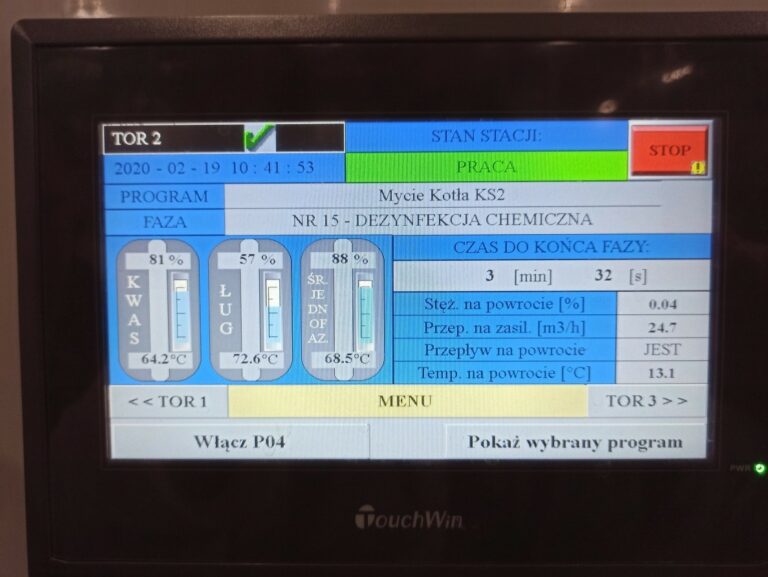
CIP station modernisation in a dairy – a new cleaning programme without changing the PLC
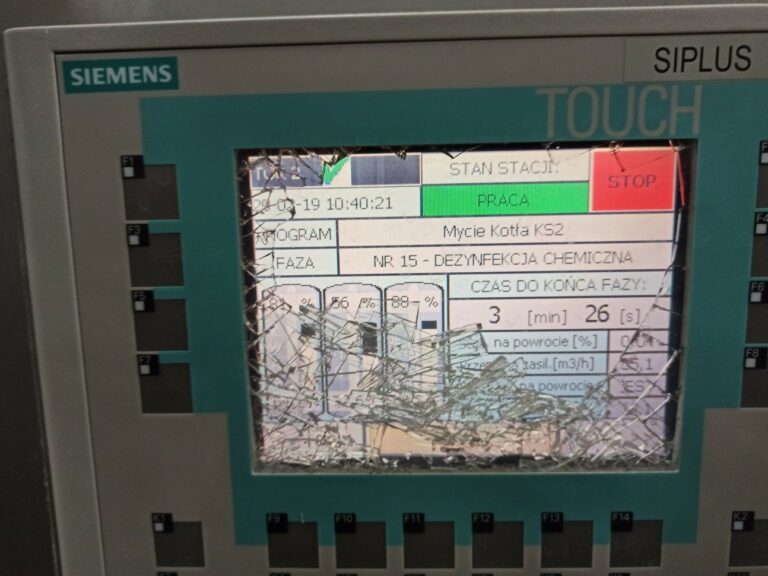
In one dairy the Siemens OP 177 series operator panel controlling the CIP station failed; without the panel the station could not start any cleaning programme, and replacement with an original panel would have involved a high cost and a long lead time. The existing visualisation was recreated on a Xinje TG765-ET panel mounted in the control cabinet door, and communication with the Siemens S7-300 PLC was configured afresh through the controller’s PROFINET interface. The controller with its program and the installation remained unchanged, and the screen layout, alarms and data history were retained. The result was a saving of about 70% against the price of the original panel, completion in under a week from order and no need for operator training. The details are described in the case study ‘CIP Station Modernisation – Xinje TG HMI Panel’.

From the point of view of automation in a dairy, the second stage, carried out after the panel replacement, is the significant one. At the user company’s request a further cleaning programme was added without modifying the program in the S7-300: the settings of the additional programme were stored in the panel’s memory registers, and C-language scripts running on the panel overwrite the parameters of the existing programme in the controller’s memory. Such an extension entails three obligations agreed with the process technologist: a change to a cleaning programme is treated as a change to a validated process and the user company’s laboratory repeats the validation of cleaning effectiveness; access to the settings is restricted by password-protected user access levels; and the settings held in the panel are also recorded in the panel project and in the documentation so that they do not become a single point of failure, with the base and additional programmes distinguished in the cleaning records, which log the parameters read back from the PLC. Independently of this, the employer assesses whether the new settings increase the risk to operators. The retained controller belongs to a product family that Siemens is phasing out: since 1 October 2025, S7-300 CPUs and I/O modules have been available only as spare parts in service quantities or through the repair service, and the manufacturer names the S7-1500 as the successor. Migration to a new controller is therefore best planned before service stocks run out. The scope of a modernisation can be matched to the budget – from replacing the panel alone to replacing the controller; the variants are discussed in our article ‘Machine Retrofit or a New Machine?’.
The most frequently automated processes in a food plant
Beyond cleaning, automation in the food industry concentrates on a few areas in which control brings repeatable quality, raw-material savings and process documentation.
- Thermal processing – pasteurisation with temperature control, a holding tube and a flow diversion valve which, when the temperature at the holding tube outlet drops below the setpoint, returns product to the balance tank; every diversion and the temperature profile are recorded. For milk, the pasteurisation parameters (72 °C for 15 s or equivalent) and the recording obligation follow from Regulation (EC) No 853/2004 in conjunction with Annex II, Chapter XI of Regulation 852/2004.
- Dosing and recipes – gravimetric or flow-based dosing of ingredients according to recipes from the panel, with batch and quantity logging.
- Filling, capping, labelling – control of packaging machines, net-weight and closure-presence checks, integration with marking systems.
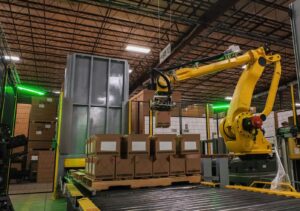
- End of line – carton forming, case packing and palletising; the conditions under which a robot replaces manual work at the line are discussed in our article ‘Robotic Palletising and Packaging’, and an example of packaging machine control is the carton forming machine with a PLC controller.
- Quality control and traceability – checkweighers, metal detection, vision systems checking labels and closures, batch data logged in the user company’s system.
- Modernisation of existing machines – replacement of worn-out controllers and panels in machines with sound mechanics; most often the first project, because it brings a quick result without interfering with the process. The scope of services is described on the machine retrofit and HMI panels and PLC controllers pages.
Commissioning and documentation of automation in a food plant
The windows for commissioning are short and often fall at night or at the weekend; the schedule is agreed with the process technologist, and the work is carried out under the site’s hygiene rules. The safety functions protecting people – interlocking of the tank manway during cleaning, interlocking of access to the concentrate dosing area – are designed to EN ISO 13849-1:2023, with the required performance level PLr determined from the risk assessment separately for each function; cleaning and disinfecting solutions at up to 85 °C are a chemical and thermal hazard, and hot water for thermal disinfection a thermal one, so the station is fitted with a ‘CIP in progress’ indication and an emergency shower, and the emergency stop remains a complementary measure.
The scope of data logging has to be defined: the operator panel stores trends and alarm history in an internal memory of limited capacity and exports them to a USB drive as CSV files, whereas longer retention, protection of records against modification and integration with the user company’s system require a data logger, a SCADA system or a data gateway – the relationship between them is described in our article ‘SCADA and MES Systems’. Electronic records can replace handwritten record sheets only if the HACCP plan provides for them and the records are backed up and reviewed in a documented manner. The documentation on completion comprises a process flow diagram with measuring points, a signal list and a register map, a description of recipes, a list of the phases of each cleaning programme with start and exit conditions, backup copies of the panel project and the PLC program, and a commissioning report. Validation of cleaning effectiveness remains with the user company’s laboratory; the integrator supplies the parameter records on which it is based. Remote diagnostics over an internet connection allows the state of the control system to be checked without a site visit; the PLC itself is not exposed directly to the internet. Since 3 April 2026, a medium-sized or larger business engaged in the industrial production or processing of food has, as a rule, qualified as an important entity under Poland’s amended Act on the National Cybersecurity System, which transposes Directive (EU) 2022/2555 (NIS2). Such an entity must implement an information security management system covering, among other things, an access control policy and the security of the supply chain for ICT products and services; businesses covered from the day the Act entered into force have 12 months to do so, i.e. until 3 April 2027. In non-binding guidance, Poland’s Ministry of Digital Affairs states that the statutory definition of an information system also covers industrial automation systems, and recommends multi-factor authentication, for example for remote logins – in such a business this also applies to service connections used for diagnostics.
Frequently asked questions
What is a CIP station and what does it consist of?
A CIP (clean-in-place) station is a set of equipment for cleaning pipework, tanks and process equipment without dismantling them. It consists of solution and water tanks, supply and return pumps, a heat exchanger, concentrate dosing pumps, valves and sensors; a PLC runs a programmed sequence of rinses and cleaning phases, controlling the temperature, flow, concentration and duration of each phase. It is used in dairies, breweries, beverage bottling plants and fruit processing plants.
What is the difference between IP69 and IP69K?
IP69 is an ingress protection rating under IEC 60529 (Amendment 2:2013) confirming an enclosure’s resistance to a water jet at 80 °C and 80–100 bar from close range, while IP69K denotes the equivalent test in the automotive standard ISO 20653. In industrial practice the two are used interchangeably; the specification should state which standard the manufacturer’s declaration refers to.
Can a new cleaning programme be added to a CIP station without changing the PLC program?
Yes, if the new programme is a parameter variant of an existing one: the settings are stored in the operator panel’s registers, and scripts on the panel overwrite the parameters in the PLC’s memory without changing its program – this is how we extended an S7-300-controlled CIP station in a dairy. The change requires the employer to assess the risk of the new settings and the user company’s laboratory to repeat the validation of cleaning effectiveness; the settings must also be protected by password-protected user access levels and recorded in the documentation and in a copy of the panel project. A programme with a different phase sequence requires a change in the PLC.
How long does a CIP cycle take?
Typically 45 to 90 minutes for a tank and 1.5 to 2.5 hours for a pasteuriser with a full alkaline, acid and thermal disinfection programme; a short rinse of pipework between products takes a few minutes but is not a full CIP cycle. Conductivity measurement shortens the rinses, whereas counting the phase time from the moment the conditions are reached on the return lengthens the cycle compared with a simple timer – in return it gives certainty that the whole circuit was cleaned under the set conditions.
Which standards apply to machinery in the food industry?
Hygiene requirements for machinery are set out in EN 1672-2:2020 and EN ISO 14159:2008, requirements for materials in the food area in Regulation (EC) No 1935/2004, production hygiene rules in Regulations (EC) No 852/2004 and 853/2004, and machinery safety requirements in Directive 2006/42/EC (replaced from 20 January 2027 by Regulation (EU) 2023/1230), together with EN ISO 12100 and EN ISO 13849-1. Until 19 January 2027 the presumption of conformity for hygiene rests on EN 1672-2:2005+A1:2009 (the 2020 edition is not listed among the harmonised standards under Directive 2006/42/EC); from 20 January 2027 the list of standards cited under Regulation (EU) 2023/1230 applies and should be checked before relying on the presumption.
A quotation for automation in your food plant
Modernising the control system of an existing machine falls within PLN 30,000–50,000 (roughly €7,000–12,000), a semi-automatic machine within PLN 50,000–150,000 (roughly €12,000–35,000) and a robotic cell within PLN 150,000–500,000 (roughly €35,000–115,000); replacing the operator panel alone is usually cheaper – in the dairy described above it was completed in under a week from order. The cost components are discussed in our article ‘How Much Does Production Line Automation Cost?’. The position within those ranges is decided by the hygienic design of the components, the scope of data logging and the amount of work in the short windows between production and cleaning.
If a CIP station, pasteuriser or packaging line in your plant runs on a control system for which parts are running out, or if you still record process parameters by hand – show us the installation. We visit, review the controls and documentation together with your process technologist, and within 48 hours of the visit send a preliminary quotation with the scope of work. The visit and the preliminary assessment are free of charge and involve no obligation.
Call +48 796 019 414, write to biuro@automation.net.pl or fill in the contact form. We carry out projects throughout Poland.