Robotic palletising and packaging — when does a robot replace manual end-of-line work?
When a palletising robot replaces manual end-of-line work: criteria, robot and gripper selection, station requirements and safety, cost PLN 150,000–500,000 net, payback 12–36 months.
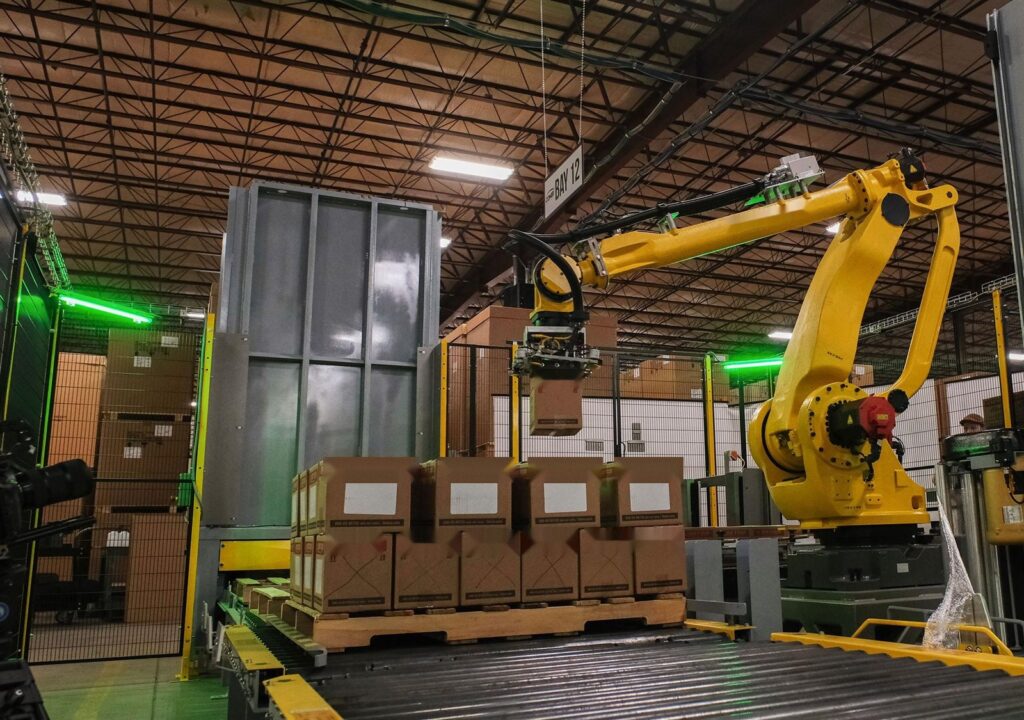
A palletising robot replaces manual end-of-line work when three conditions are met at once: the units leaving the line are repeatable in mass and geometry, the required throughput is stable enough to justify a fixed station, and the cost of manual handling – wages across shifts, lifting injuries, output that drops towards the end of a shift – exceeds the cost of a station that pays for itself within 12–36 months. Where any of these conditions is absent, a robotic palletising cell becomes a costly fixed asset awaiting a product that suits it.
This article sets out the criteria for that decision from the perspective of an industrial automation integrator based in Poland, working nationwide, which supplies palletising and depalletising systems tailored to a particular production line.
Table of contents
End-of-line processes commonly robotised
End-of-line automation covers everything between the last packing machine and the loaded vehicle. The tasks commonly handed over to a robot include:
- palletising cartons, trays, shrink-wrapped packs and crates in a repeatable pattern;
- palletising bags – animal feed, flour, granular products, construction chemicals such as cement and tile adhesive – with fork or clamp grippers;
- depalletising of incoming goods or empty packaging onto the line;
- case packing, often combined with palletising in one cell;
- handling of finished assemblies such as wooden crates or furniture components.
Packaging automation upstream of the pallet – carton erecting, filling, closing, labelling – is frequently addressed in the same project or the step before it. A carton forming machine built on a Xinje XC-series PLC for a packaging-industry client is an example; a palletiser is then a natural next element of such a line.
Robot throughput versus manual work
A comparison in units per hour is misleading if it ignores the shape of the shift. An operator stacking bags achieves one rate at the start of a shift and typically a lower one at its end, and is bound by manual handling limits (in Poland, 30 kg for men and 12 kg for women in regular work, 50 kg and 20 kg occasionally, with lower limits for lifting above shoulder height); a robot keeps the same cycle time on the first and the last pallet, on every shift. The benefit of a palletising robot therefore lies less in peak speed than in constant, predictable throughput that can be planned against the upstream line. It also removes the lifting that often makes end-of-line positions hard to staff.
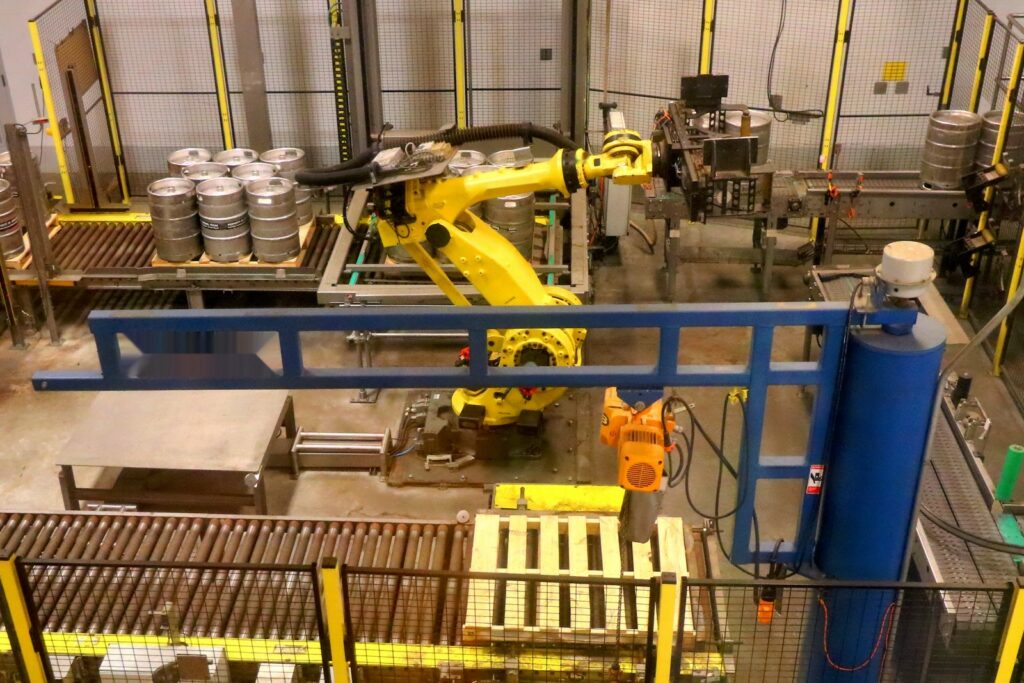
The throughput of a robotic palletiser depends on unit mass, stacking pattern, layer height and whether the gripper picks one unit or a whole row; quoting a number without knowing the product would be speculation. As a reference point, one of the company’s published projects – a robotic crate assembly station for the timber industry – reaches more than 400 cycles per hour and raised output by over 40% compared with the previous manual process. This is an assembly application, not a palletising one; it illustrates the class of repeatable handling task in which a robot outperforms manual work.
Selecting a robot and gripper for palletising
Selection begins with the product, not the robot; the following need to be established first:
- unit mass, dimensions and their variability between batches;
- required throughput in cycles per hour, including peaks;
- pallet height and pattern, number of formats and time available for changeover;
- reach to the furthest column on the furthest pallet;
- payload, calculated together with the gripper, not for the product alone;
- required repeatability and the time allowed for pallet changeover.
Three classes of robot are used for palletising:
| Robot type | Advantages | Limitations | Typical application |
|---|---|---|---|
| 4-axis industrial palletiser | High speed, large reach and payload; simple kinematics suited to stacking | Stacks units flat, rotating only about the vertical axis; requires the whole motion zone to be safeguarded — in practice full guarding | High-throughput palletising of cartons and bags |
| 6-axis industrial robot | Full freedom of orientation; easily combined with case packing or depalletising | Requires the motion zone to be safeguarded, usually guarding; more complex programming; typically lower payload at comparable cost | Mixed tasks: palletising with reorientation, irregular units, combined cells |
| Collaborative robot (cobot) | Compact footprint, relocatable; may operate with reduced guarding after a risk assessment | Lower speed and payload; collaboration must be confirmed by the risk assessment, not assumed | Low- and medium-throughput palletising of light units where space is tight |
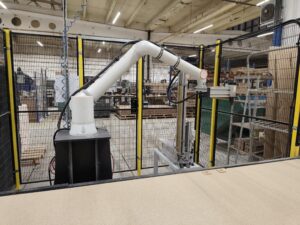
The company has experience with Fairino collaborative robots, including the FR10 and FR20 models (payload 10 kg and 20 kg respectively), which represent the cobot class in the table. The reach of arms in this class (of the order of 1.4–1.8 m) is usually insufficient to build a full-height pallet on two positions; the station then needs a lifting column as an additional axis, which must be allowed for both in the price and in the risk assessment.
The gripper is frequently harder to specify than the robot itself. Vacuum grippers suit cartons and film-wrapped packs but are sensitive to surface quality – dusty, porous or perforated board reduces holding force – and with heavier cartons the load is carried by the lid closure, so poorly sealed cases need full-area suction or a gripper with underside support. Fork grippers (with a top clamp) handle bags regardless of surface condition; clamp grippers need units that tolerate side pressure — multipacks and light cartons are handled with a clamp plus underside support, or with vacuum and a foam plate; combined grippers serve several product types at the cost of mass and complexity. Gripper trials on the actual product should precede the final layout.
Station requirements: space, infeed and safety
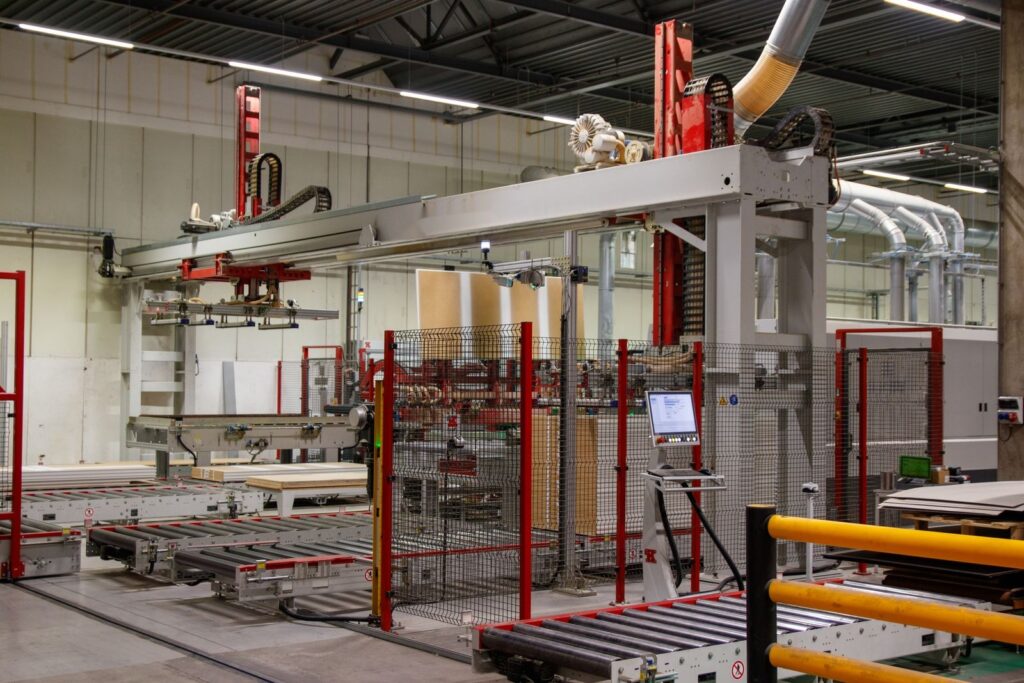
A robotic palletiser requires a pallet zone – usually two positions, so that one pallet is loaded while the other is exchanged – plus the robot’s working envelope and safety zone. In existing plants the obstacle is frequently not the robot itself but the lack of room for full pallets and a forklift route outside the guarded area. On the infeed side, a conveyor with a positioning stop and a presence sensor is typical, so that the robot picks each unit in a known orientation.
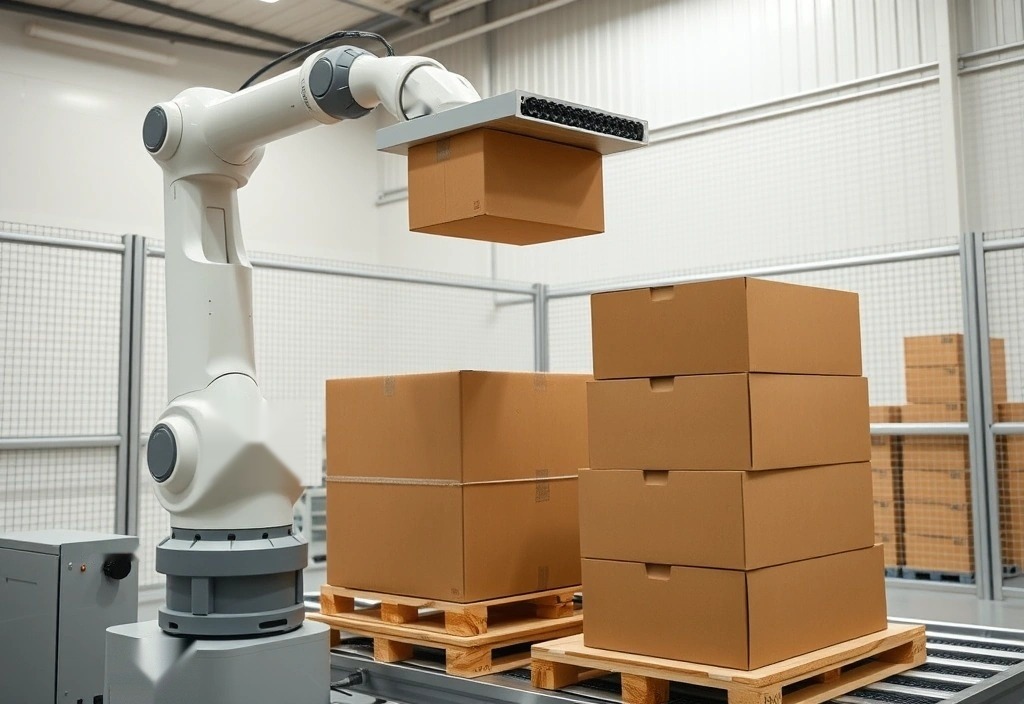
Safety design follows from the risk assessment, not from the type of robot. Industrial palletisers operate within fixed guarding with interlocked doors; the pallet changeover zone is usually protected by light curtains or area scanners — and because a person can walk fully into that zone, restarting after a curtain interruption requires a manual reset from a point with a clear view of the zone, or a presence-detecting scanner. If the robot is to keep working on the second pallet position while the first is being changed, the safety system must confine the robot’s motion to the closed position — via safe zone monitoring in the robot controller or a safety controller, with a separate protective device for each position; without that function the robot must stop for every changeover so that a full pallet can be removed while the robot continues on the second position. Safety functions may be implemented with safety relays or a safety controller — provided the required performance level is achieved (typically PL d, category 3 under EN ISO 13849-1 and EN ISO 10218-1 for robotic stations, unless the risk assessment indicates otherwise) — including over networks such as PROFIsafe, CIP Safety or FSoE; a hard-wired circuit is not the only compliant solution. The choice rests with the integrator; what matters to the buyer is that the safety system falls within the scope of the station’s risk assessment, documentation and CE marking. Under EN ISO 13850 the emergency stop must be a manually operated, latching device with positive opening contacts – typically a mushroom-head push-button – and a touchscreen button does not meet this requirement. Collaborative operation of cobots is governed by EN ISO 10218 – the 2025 edition of part -2 absorbed the former ISO/TS 15066, including permissible forces and pressures; reduced guarding is the outcome of a documented risk assessment, not an attribute of the cobot itself.
Where a robot is added to an existing line, Regulation (EU) 2023/1230 – replacing Directive 2006/42/EC from 20 January 2027 – treats a change in risk, not in output, as the criterion for a substantial modification. Which act applies is decided by the date the station is put into service, so with a 3–6-month lead time, projects ordered in the second half of 2026 should be run under the Regulation from the outset.
What determines the price of a palletising station
A palletising cell, like any complete robotic workstation, falls within PLN 150,000–500,000 net (approx. EUR 35,000–115,000). Position within that range depends mainly on the robot class and payload, the gripper (often a significant share of the price), the number of pallet positions and conveyors, the extent of guarding, integration with the upstream control system, and the number of formats to be programmed. Simpler semi-automatic machines without a robot lie within PLN 50,000–150,000 (EUR 12,000–35,000).
The lead time for a robotic station is 3–6 months from contract to acceptance. Payback periods for well-matched projects are 12–36 months, and a well-chosen first project typically pays for itself within 12–24 months. Where a project lands in that range depends above all on the number of shifts and the number of manual palletising posts the robot takes over: with three-shift operation payback sits near the lower end, with a single shift and a single operator near the upper end or beyond it; the assumptions are discussed in the article on how much production line automation costs. The scope of supply for robotic workstations is described on the offer page.
When a palletising robot is not justified
End-of-line automation is not the right first step in every plant. The case for a palletising robot is weak where:
- very low repeatability of units, where each pallet is effectively different;
- frequent format changes without time for changeover — a new pattern is generated in software in minutes, but where formats need different grippers or different infeed datums, the changeover takes time and erodes the gain;
- no floor space for the pallet zone and a separate forklift route;
- units of unstable geometry – loosely filled bags of variable shape are demanding for vacuum and clamp grippers alike;
- throughput so low that the robot would stand idle for most of the shift.
The alternative is then a semi-automatic solution (PLN 50,000–150,000, approx. EUR 12,000–35,000 — e.g. a vacuum manipulator that lets the operator guide a carton without bearing its weight; the scale of effect is illustrated by the shaver head assembly machine: threefold throughput at zero defects), or the first project may lie elsewhere on the line. The article on where to start with production automation describes how to identify the station where automation pays back fastest, and the article on what production process robotisation is sets out the general criteria for such a decision.
The same arithmetic applies to assembly: a separate article covers furniture production automation, using a robotic bed box assembly cell as the example.
Frequently asked questions
How much does a robotic palletiser cost?
A robotic palletising cell, like any robotic workstation, is priced within PLN 150,000–500,000 net (approx. EUR 35,000–115,000), depending on robot class, gripper, pallet positions, guarding and integration. Semi-automatic machines without a robot fall within PLN 50,000–150,000 (EUR 12,000–35,000). A quotation follows within 48 hours of the site survey.
Can a cobot palletise without a safety fence?
Not as a rule. A collaborative robot may operate with reduced guarding only when a documented risk assessment confirms — EN ISO 10218-1/-2 applies to every robotic station regardless of robot type, with collaborative operation covered by the 2025 edition of part -2 — that forces, pressures and speeds remain within permissible limits for the specific gripper and product. The outcome may equally be a scanner-monitored zone with reduced speed on approach, or conventional guarding.
How long does it take to implement a palletising station?
For a robotic station, 3–6 months from signing the contract to acceptance, covering design, gripper trials, manufacture, installation, safety validation and training. Payback is expected within 12–36 months; a well-chosen first project usually pays back within 12–24 months.
Does adding a robot to an existing line require new CE marking?
Usually, yes. Under Regulation (EU) 2023/1230, which replaces Directive 2006/42/EC from 20 January 2027, the criterion for a substantial modification is a change in risk not covered by the existing protective measures – not an increase in output. Adding a robot generally introduces new hazards, so a risk assessment of the modified assembly is needed in any case.
Which products are difficult for a palletising robot?
Units of unstable or variable geometry – loosely filled bags, bundles without a fixed shape, cartons whose surface is unsuitable for vacuum grippers – and lines where the format changes every few pallets. A bag-flattening conveyor, a combined gripper or a larger pattern library may help, but the added cost must be weighed against the base case.
Request a quote
If you palletise by hand today and want to know whether a robot is justified on your line, send a short description of the product, the current throughput and a photo of the end of the line. For the site survey it helps to have ready: a list of formats with unit mass and dimensions, the pallet patterns, volume per shift and number of shifts, a sketch or photos of the space at the end of the line, and the utilities available (compressed air, power supply). Site surveys are carried out across Poland, and you will receive a quotation within 48 hours of the survey. Call +48 796 019 414, write to biuro@automation.net.pl or use the contact form.
Automation Dariusz Kulik is an industrial automation integrator based in Białystok, Poland, with 15 years in business and projects delivered nationwide.