How Much Does Production Line Automation Cost? A Guide to Costs and Return on Investment
How much does production line automation cost? See the cost breakdown, realistic price ranges for typical projects and how to calculate the return on investment (ROI).
„How much will it cost?” — this is the first question raised at almost every meeting with a client considering production line automation. Although the honest answer is „it depends”, in this article we show exactly what the cost of automating a production line depends on, what the realistic price ranges for typical projects are, and how to calculate when the investment will pay for itself. After 15 years of implementations in manufacturing plants, experience indicates that a properly calculated project is justified by its own figures.
Table of contents
Components of the cost of production automation
The price of an automation project is not confined to „the machine” or „the robot”. The total implementation cost consists of four main items:
1. Design and concept
Process analysis, measurements on the shop floor, technical concept, technology selection, mechanical and electrical design, documentation. In small projects this is usually 10–15% of the budget. It is also the most important stage, since errors made in the concept phase subsequently prove many times more costly than the design itself.
2. Components and materials
PLC controller, HMI operator panel, drives (frequency inverters, servo drives), sensors, safety components, mechanical structure, control cabinet, wiring. In a typical project, components account for 40–55% of the cost. This is also the area offering the greatest scope for optimisation: appropriately selected mid-range components frequently perform the same function as premium solutions, at a fraction of the price. We wrote more about controller selection in our article on PLC controllers — types, programming and selection.
3. Assembly, programming and commissioning
Control cabinet prefabrication, mechanical and electrical installation on site, PLC and HMI programming, testing, start-up with the production crew, operator training. This is 30–40% of the budget and simultaneously the stage at which the integrator’s experience is most decisive: an efficient start-up entails less downtime in production.
4. Service and maintenance
A cost readily overlooked at the quotation stage: inspections, spare parts, technical support, minor modifications after launch. Provision should be made for 3–5% of the investment value per year. A local integrator has an advantage in this respect: service response times are measured in hours rather than days.
Production line automation: indicative price ranges
Every project is quoted individually; on the basis of completed implementations, however, indicative ranges can be given for three typical scenarios:
Semi-automatic production station: PLN 50,000–150,000 (approx. €12,000–35,000)
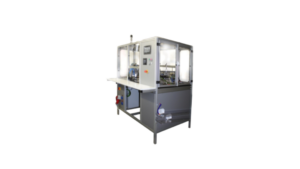
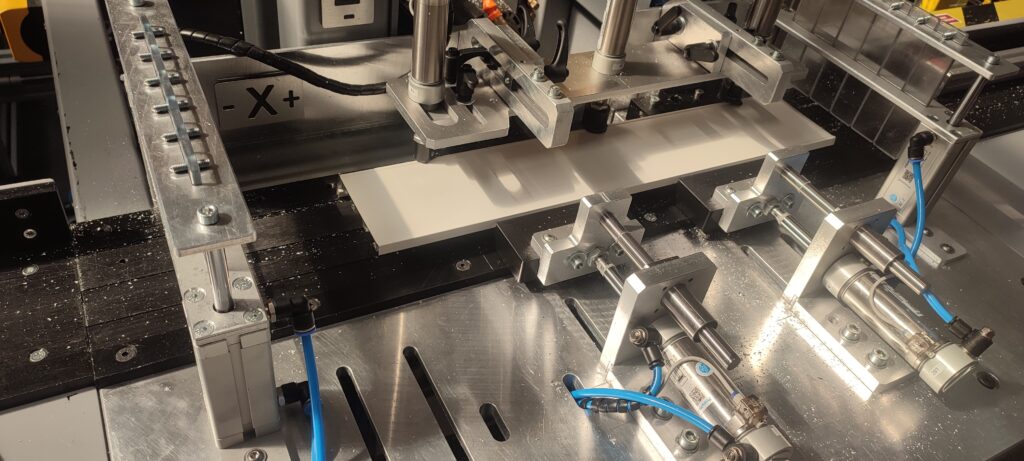
A station where the operator loads and unloads the part, and the machine performs a repeatable operation: assembly, welding, dosing, inspection. PLC controller, HMI panel, pneumatic or electric drives, safety light curtain. An example from our practice: a semi-automatic machine for assembling shaver heads with an HMI panel and a servo drive.
Robotic workstation: PLN 150,000–500,000 (approx. €35,000–115,000)
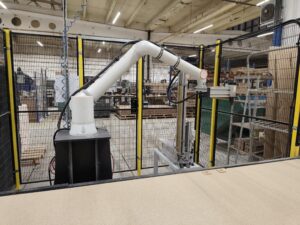
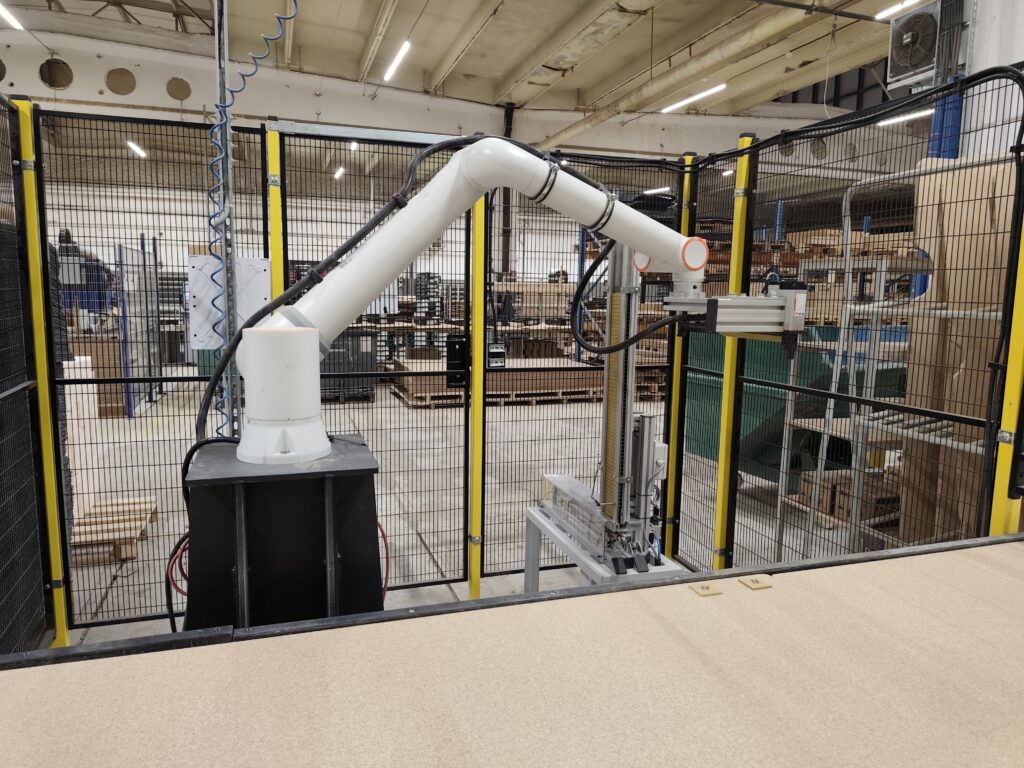
An industrial robot or cobot with a gripper, feeders, safety fencing and integration with the existing line. The price is determined principally by the robot’s payload and reach, the number of product variants and the method of part feeding. Typical applications: palletising, machine tending, assembly. See our crate assembly robot, which automated packaging production.
Modernisation (retrofit) of an existing line: PLN 80,000–400,000 (approx. €19,000–93,000)
Replacing outdated controls with new ones: a new PLC, HMI panels, frequency inverters, sensors and safety circuits — while keeping the sound mechanics. This frequently represents the fastest return on investment, since for 20–30% of the price of a new line the plant regains operational reliability and parts availability for many years.
The above net amounts are indicative — the final price depends on the scope, the number of product variants and the conditions in the plant. A specific quotation is prepared free of charge following analysis of the process.
Calculation of the return on investment (ROI) in automation
The simplest model applied in discussions with clients is based on three sources of savings:
- Labour costs — if a station frees up one full-time position per shift, with two shifts and a total employer cost of approx. PLN 8,000/month, this gives around PLN 190,000 (approx. €44,000) in savings per year. Employees usually remain with the company; they are transferred to tasks for which manpower was previously lacking.
- Throughput — a machine operates at a constant cycle time, without breaks or fluctuations in performance. A 20–40% increase in throughput at the line’s bottleneck is often the main source of return.
- Quality and scrap — a repeatable process means fewer complaints and less waste. In industries with expensive raw materials (food, aluminium), scrap reduction alone can finance the implementation.
Example: a robotic workstation costing PLN 300,000 (approx. €70,000), which frees up one full-time position on two shifts (approx. PLN 190,000/year) and increases throughput by 15% (conservatively assumed at PLN 60,000/year in margin), pays for itself in less than 15 months. The typical payback period of the projects we deliver is 12–36 months.
Hidden costs that are rarely discussed
A reliable quotation should also include items that often „disappear” from low-priced offers:
- Production downtime during installation — a competent integrator may be recognised by the planning of commissioning in stages or during weekend shutdowns.
- Infrastructure adaptation — power supply, compressed air, flooring for the robot, industrial network.
- Training for operators and maintenance staff — in its absence, even the best machine will remain idle at the first minor fault.
- Documentation and safety compliance — risk assessment, declaration of conformity, CE marking for the machine assembly.
- Spare parts to start with — a set of critical parts held in stock reduces potential downtime from days to minutes.
The starting point
The point of departure is not a robot catalogue but the process itself. The best results are obtained by automating the bottleneck: the point at which the line loses the most time or at which employees are most difficult to recruit. An appropriate first step is a short analysis on the shop floor: the process is walked through, cycle times are measured, operators are consulted, and an indication is given of what should be automated first in order to achieve the fastest return. You will find the full scope of our services in our production automation and robotics offer.
The practical side of these topics — scope of work, budget bands and lead times — is described on the robotic workstations and automation cells and machine retrofit and modernisation service pages.
Frequently asked questions
How much does the simplest station automation cost?
Simple applications — e.g. a dosing unit, a rotary table with sensors or a press with a safety light curtain and new controls — start at approx. PLN 30,000–50,000 (approx. €7,000–12,000) net. The upper limit depends on the complexity of the process and the number of product variants.
Does automation pay off with short production runs?
Increasingly, the answer is affirmative. The decisive factor is rapid changeover: recipes stored in the HMI panel, servo drives instead of mechanical adjustments, interchangeable grippers. For short runs, cobots also perform well, as they can be relocated between stations.
How long does an automation project take?
Measured from contract signature to acceptance on the shop floor: a semi-automatic station takes 2–4 months, a robotic workstation 3–6 months, and a line control modernisation — usually 1–3 months, with installation planned during production shutdowns.
Is funding available for automation?
Yes — manufacturing companies in Poland can benefit from the robotisation tax relief and from regional and national programmes. Assistance is provided in preparing the technical specification for the application. Funding will be addressed in greater detail in a separate article.
Let’s talk about your production
Wondering how much automation would cost in your plant? We will visit your site, walk the line with you and show you where automation will pay back fastest. The visit is free and without obligation, and you receive a budget quotation within 48 hours of the visit. We are based in Białystok, Poland, and deliver projects across Poland.
📞 Call: +48 796 019 414
✉️ biuro@automation.net.pl
📍 Automation Dariusz Kulik, Ciesielska 2/20, 15-542 Białystok, Poland – contact details